


Hey there! As a supplier of Non-return Valves, I've had my fair share of experiences with these nifty devices in all sorts of environments. Today, I wanna chat about how they perform in a corrosive gas environment.
First off, let's quickly go over what a Non-return Valve is. It's a type of valve that allows fluid (or gas in our case) to flow in only one direction. Pretty simple, right? You can check out more details about Non-return Valve.
Now, when it comes to corrosive gas environments, things can get a bit tricky. Corrosive gases, like chlorine, sulfur dioxide, or hydrogen sulfide, have a knack for eating away at materials. This can spell trouble for Non-return Valves if they're not properly designed and made.
One of the key factors that determine how well a Non-return Valve performs in a corrosive gas environment is the material it's made of. For instance, if you use a valve made of regular carbon steel, it's gonna start rusting and corroding pretty quickly when exposed to corrosive gases. That's why we often opt for more corrosion-resistant materials. Stainless steel is a popular choice. It has a high chromium content, which forms a passive oxide layer on the surface. This layer acts as a shield, protecting the underlying metal from the corrosive effects of the gas. There are different grades of stainless steel, and we choose the one that best suits the specific corrosive gas and the operating conditions.
Another great option is plastic materials like PVC (polyvinyl chloride) or PTFE (polytetrafluoroethylene). PVC is relatively inexpensive and offers good resistance to many common corrosive gases. PTFE, on the other hand, is super resistant to a wide range of chemicals and has excellent non-stick properties. It can handle even the most aggressive corrosive gases.
Let's talk about some specific types of Non-return Valves and how they hold up in corrosive gas environments. The Single Disc Swing Check Valve is a common type. It has a disc that swings open when the fluid or gas is flowing in the right direction and closes when the flow reverses. In a corrosive gas environment, the disc and the hinge mechanism are at risk of corrosion. If the disc gets corroded, it may not seal properly, leading to leakage. That's why we make sure to use corrosion-resistant materials for these parts. The hinge should also be designed in a way that it can withstand the corrosive effects without losing its functionality.
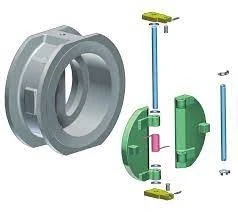
The Wafer Check Valve is another popular choice. It's compact and easy to install between flanges. In a corrosive gas environment, the sealing surfaces of the wafer check valve are crucial. Any corrosion on these surfaces can cause the valve to leak. We use special coatings and materials on the sealing surfaces to prevent corrosion. For example, we might apply a PTFE coating, which not only provides corrosion resistance but also reduces friction, making the valve operate more smoothly.
Now, it's not just about the materials. The design of the Non-return Valve also plays a big role in its performance in a corrosive gas environment. A well-designed valve will have smooth internal surfaces. Rough surfaces can trap corrosive gas and moisture, accelerating the corrosion process. We also make sure that there are no crevices or dead spaces where the gas can accumulate and cause localized corrosion.
Maintenance is also key. Even the best-designed and made Non-return Valves need regular maintenance in a corrosive gas environment. We recommend inspecting the valves periodically for signs of corrosion, such as pitting, rust, or discoloration. If any corrosion is detected, we can take appropriate measures, like replacing the corroded parts or applying additional protective coatings.
In addition to the material and design, the operating conditions in the corrosive gas environment also matter. Factors like temperature, pressure, and the concentration of the corrosive gas can all affect the performance of the Non-return Valve. Higher temperatures can speed up the corrosion process, so we need to choose materials that can withstand the specific temperature range. Similarly, high pressures can put more stress on the valve components, so the valve needs to be designed to handle these pressures.

When it comes to choosing the right Non-return Valve for a corrosive gas environment, it's important to consider all these factors. We work closely with our customers to understand their specific requirements. We take into account the type of corrosive gas, the operating conditions, and the budget. Based on this information, we can recommend the most suitable valve and provide all the necessary technical support.
So, if you're dealing with a corrosive gas environment and need a reliable Non-return Valve, don't hesitate to reach out. We've got the expertise and the products to meet your needs. Whether it's a Single Disc Swing Check Valve, a Wafer Check Valve, or any other type of Non-return Valve, we can help you find the perfect solution.
In conclusion, Non-return Valves can perform well in a corrosive gas environment if they're made of the right materials, have a proper design, and are well-maintained. With our experience and knowledge, we're confident that we can provide you with a valve that will stand up to the challenges of your corrosive gas application. So, let's have a chat and see how we can work together to solve your valve needs.
References:
- "Valve Handbook: Principles and Applications" by Thorkild Skogestad
- "Corrosion Engineering" by Fontana and Greene