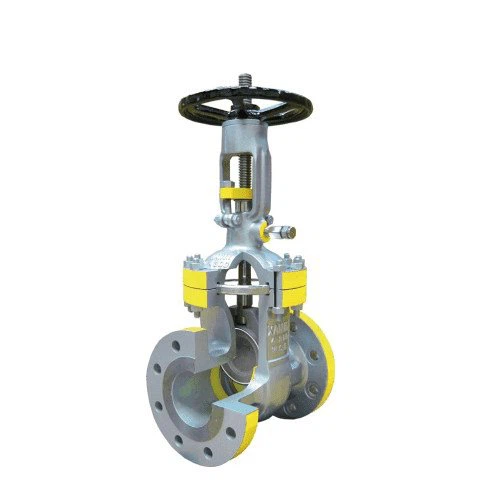
What Is Gate Valve?
A gate valve can be defined as a type of valve that uses a gate or wedge-type disk, which moves perpendicular to flow to start or stop the fluid flow in piping. It is the most common type of that used in any process plant. It is a linear motion valve used to start or stop fluid flow. In service, the valve position is either fully open or fully closed gate.
Rich experience
The company' s founder team graduated from mechanical and electrical automation majors and has been engaged in the valve industry for more than 20 years. It is committed to providing customers with a complete set of fluid control solutions. It is a company integrating scientific research and development, A large-scale valve enterprise integrating testing and testing, manufacturing and sales.
Wide product range
The company mainly produces API 6D pipeline ball valves, gate valves, globe valves, check valves, plug valves and API 609 series butterfly valves in 6 categories, with more than 1,000 specifications and varieties. Products widely cover petrochemical, coal chemical, nuclear power, LNG, marine, aerospace, metallurgy, papermaking and other industries.
Complete qualifications
The company has a complete international standardized management system, adopts the world's top precision casting technology and modern intelligent electronic detection system, and uses advanced SAP resource management, strip storage management system and ERP system to effectively manage the factory.
High standard products
After years of hard work and development, it has become a key backbone enterprise in the valve industry. It specializes in improving the innovation and manufacturing capabilities of special valves in harsh industrial environments. High-quality products and fast after-sales service have won praise and trust from customers at home and abroad.
Advantages of Gate Valve
Efficiency in controlling the flow of media
Gate valves are exceptional at managing the flow of fluids. When the gate is entirely lifted, it allows for a full bore, meaning that fluids can pass through the valve without significant resistance.
Longevity and reliability
One of the major strengths of gate valves is their reliability. They are built to last and provide consistent performance over time. The simple yet robust design contributes to their long service life.
Automation capabilities
The adaptability of gate valves for automation is a notable benefit. In an age where automation is increasingly valuable, the ability to remotely control gate valves is a significant advantage. It allows for better control, efficient operation, and reduced labor costs.
Cost-effectiveness
Gate valves are cost-effective solutions for flow control. Their robust design, combined with their efficiency and longevity, results in lower overall costs. Whether in initial investment or in terms of maintenance and operational costs, gate valves typically offer excellent value.
Safety
Safety is another crucial benefit that gate valves offer. Their ability to completely stop the flow of fluids makes them indispensable in systems where there’s a need to halt flow quickly, especially in the event of a system malfunction.
Wedge gate valves
These valves use a wedge-shaped gate. The slight angle on the gate’s faces allows it to seal tightly against the valve seats. Wedge gate valves are versatile and can handle various fluid types and pressures.
Slab gate valves
A slab gate valve uses a flat gate that slides between two parallel seats. This design is particularly useful in oil and gas applications. The slab gate allows for a full bore, reducing turbulence and pressure drop. Most slab gate valves are affiliated with API-6D specifications.
Knife gate valves
As the name suggests, a knife gate valve has a sharp-edged gate that can cut through thick and viscous media, like sludge or pulp. These valves are common in wastewater treatment and paper industries.

The stem is used to move the valve to its open and closed positions. This stem can be a screw—in the case of manually actuated valves—or a smooth shaft if actuated by a pneumatic cylinder. The stem is usually sealed by means of a gland packing seal arrangement or a set of o-rings.
The bonnet of a gate valve sits on the top of the valve body and is where the spindle passes through. The bonnet can usually be removed from the valve body as it is often connected with bolts or threads. The bonnet also houses the gland packing seals that are used to prevent fluid from leaking past the stem.
The valve actuator can either be a manually operated handwheel or it can be an automatic actuator like a pneumatic cylinder or geared motor, for example.
The disc isolates the flow and must be able to hold the pressure of the line when closed. The disc typically slides between two seats to ensure a tight seal with no leaks. There are two main categories of disc, namely wedge or parallel.
The valve body can be cast, forged, or fabricated depending on its application. Gate valve bodies can have many different process connections that can include: flanged, threaded, and welded parts. The valve body has a recess into which the gate slides.

• Gate valves are widely used for all types of applications and are suitable for both above ground and underground installation.
• Gate valves most commonly the Valves Made in Europe are designed for fully open or fully closed service and are preferably installed in pipelines as isolating valves, and should not be used as a control or regulating valves.
• Gate valves can be used in demanding environments such as high temperature and high pressure environments. They are often seen in power plants, water treatments, mining, and offshore applications.
Size
The gate valve size should match the pipe size to ensure optimal flow and prevent excessive pressure drop.
Pressure rating
The gate valve pressure rating should match the system’s operating pressure to prevent leaks and ensure safety.
Temperature rating
The gate valve temperature rating should match the system’s operating temperature to prevent damage to the valve and ensure safety.
Material
The gate valve material should be compatible with the fluid being transported to prevent corrosion and ensure longevity.
Repair and Maintenance of Gate Valve
● Before starting the repair and maintenance, ensure the system is relieved of the pressure to avoid injuries, losses, and environmental damage.
● Valve lapping. Use a Lapping machine to smooth out the valve seat and disc to enhance a tight seal when the valve closes. Using the valve for a long period leads to the formation of scales on the valve, which then interferes with disc closure and, thus, fluid leakage. Also, the build-up of these scales reduces fluid pressure.
● Lubrication. Lubricate the gate valve stem threads and stem nut to reduce friction, wear, and make it easy to open/close. Use a grease gun to do the lubrication.
● Adjust valve packing every month or as recommended by the manufacturer.
● Cleaning. Open the gate valve bonnet component and clean the valve seat, disc, and entry and exit ports to prevent fluid blockage.
● Tighten the bonnet-body bolts and nuts to the torque recommended by the gate valve manufacturer.
● Replace the disc (components that closes fluid flow) if it does not stop the fluid flow effectively. Replacement of the disc would involve opening the valve bonnet to access the valve interior.
Solid wedge
The solid wedge has been around the longest and at one time virtually all wedge gates were the solid type. The drawback to a solid design is that it does not have any flexibility and if there is any valve body/seat distortion due to extreme temperature fluctuations or pipe stresses, the solid disc can become jammed in the seats. The solid disc is still standard on bronze, cast iron, water service and compact carbon steel valves (API 602 type).
Flexible wedge
The flexible wedge type is just that: flexible. By the addition of a groove or slot around its periphery, the flexible disc can adapt to temperature changes and adverse piping stresses without binding. The flexible design also is a little easier to manufacture in that minor imperfections in the seating surface angles can be compensated for by the disc’s flexibility. The flex-wedge design is by far the most common type seen on commodity gate valves used in industrial applications.
Split wedge
The split wedge type consists of a two-piece design with mating surfaces on the back side of each disc half. These mating surfaces allow the downward stem thrust to be uniformly transferred to the disc faces and onto the seats. This flexible design also provides protection against jamming due to thermal expansion. A disadvantage to the split design is that in dirty services, residue or debris can cake in between the disc halves, causing the valve to improperly seat or even jam. Split wedge designs are commonly found on stainless steel and high alloy valves, as well as many small bronze valves.
1. PVC gate valve
PVC gate valve features
● PVC gate valves are not damaged by freezing temperatures, and these valves can also withstand temperatures up to 60°C.
● Resistant to corrosion, making these valves ideal for chemical processing applications involving highly corrosive substances.
● PVC valves are affordable compared to metal valves.
● Excellent durability offering many years of reliable use.
● Available in a wide range of sizes.
2. PVC gate valve applications
PVC gate valves are a good low-cost solution for most flow control needs at home. These valves are durable and corrosion-resistant, hence widely used in aquatic environments. A few common applications are:
● Aquatics and aquaculture
● Landscaping and irrigation
● Tank drain valves and septic systems
● Indoor plumbing
● Spas
3. Brass gate valve
Brass gate valve features
● Brass gate valves work on 0-16 bar pressure range with media temperatures from -20°C to 120°C. Hence, they can withstand higher temperatures and pressure than PVC gate valves.
● Brass is stronger than PVC, but stainless steel is the strongest.
● Brass gate valves are costly compared to PVC gate valves, but less costly than stainless steel gate valves.
4. Stainless steel gate valve
Stainless steel gate valve features
● Stainless steel is the most durable, heat-resistant, and corrosion-resistant material when compared to brass and PVC.
● Withstands very high temperature (up to 800°C) and pressure. Stainless steel can withstand a wide range of temperatures (low to high) and pressure compared to brass and PVC.
● Used to manufacture gate valve body and internal parts
● Stainless steel gate valves have a simple body design enabling ease of repair, cleaning, and maintenance
● Used in applications involving liquid, gas, and steam
● Expensive compared to PVC, brass, and bronze gate valves
● Needs a large area for installation compared to brass or PVC
Stainless steel gate valve applications
Stainless steel is extremely durable and corrosion-resistant, hence used in marine and industrial applications. Some common applications are:
● Industrial applications like transporting natural gas and crude oil
● Slurry applications
● Drinking water applications at home as the material doesn't leach into the water
5. Bronze gate valve
Bronze gate valve features
● Excellent machinability, strength, and corrosion resistance
● Used to manufacture relatively small gate valves in low-pressure applications
● Bronze gate valves are typically used for water pipes and equipment pipelines of about 300 psi (20 bar) or less, and temperatures in the range -20° C -150° C.
● Higher cost compared to PVC, but less than brass and stainless steel
● Bronze has higher corrosion resistance than cast iron, but less than PVC or brass.
● Costlier than PVC but the cost is lower than brass or stainless steel.
Common Gate Valve Bonnet Connections
Screwed bonnet
This simple body-bonnet connection offers quick access into the valve. However, they are limited to small size gate valves and low-pressure applications. When used in these applications, screwed bonnets can deliver a long-lasting, leak-proof seal and easy disassembly.
Union bonnet
In this design, a union nut rests on the lower edge of the bonnet, and screws into the threads of the valve body. As a result, it prevents the leak-proof seal from deteriorating over time. This more robust connection provides a better option than the screwed bonnet when operators require frequent bonnet removal.
Bolted bonnet
As valve sizes get larger and the working pressure increases, using flanges and bolts becomes necessary. This robust connection requires a gasket to seal the body-bonnet joint.
Welded bonnet
This option works well for designs where the operator does not require the disassembly of the body bonnet. It offers a much lighter assembly than the bolted bonnet and operates in the same pressure range.
Pressure seal bonnet
A pressure seal bonnet is specifically for high-pressure applications in excess of 1,500 psi (103 bar). It has a unique mechanism where the operation pressure helps to improve the body-bonnet joint seal as the internal pressure increases. Typically, it is used alongside bolts and flanges.
SUNAY is a professional manufacturer of valves. Headquartered in Anfeng Industrial Zone, Yongjia, Zhejiang. The company was established in 2010 with a registered capital of 10.8 million yuan and has three holding manufacturing companies. The company’s founder team graduated from mechanical and electrical automation majors and has been engaged in the valve industry for more than 20 years. After years of hard work and development, it has become a key backbone enterprise in the valve industry.
Q: Do gate valves restrict flow?
Q: When not to use a gate valve?
Q: What causes a gate valve to fail?
Q: Why do gate valves always leak?
Q: How long should a gate valve last?
Q: What is the alternative to a gate valve?
Q: What maintenance is required on gate valves?
Q: Where should gate valve be placed?
Q: How do I stop my gate valve from leaking?
Q: Can you fix a broken gate valve?
Q: Should gate valve be fully open?
Q: Can gate valves fail?
Q: Why won't my gate valve fully close?
Q: How do you test a gate valve leak?
Q: Are all gate valves full port?
Q: Which valve should never be used for flow control?
Q: Can a gate valve be installed horizontally?
Q: What are the three types of gate valves?
Q: What is the yoke on a gate valve?
Q: What is the best application for a gate valve?
We're well-known as one of the leading gate valve manufacturers and suppliers in China. We warmly welcome you to buy or wholesale customized gate valve at competitive price from our factory. Contact us for more details.
disc gate valve, air operated gate valve, wafer knife gate valve