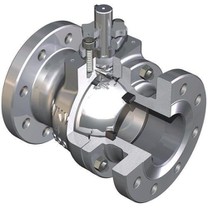



Choosing the wrong 3-way flanged ball valve can result in the pipe not being used. A 3-way flanged ball valve, one valve connected to three pipes, sounds the same, but their performance varies greatly. T-valve and L-valve are almost identical in appearance, with the difference lying the shape of the inner channel of the core. This invisible channel determines whether your pipe is running smoothly or is rendered unavailable. Choosing the wrong approach is not just a matter of "not working well," it is a matter of "causing problems."
First, the most deadly difference: L-valves should never be used for mergers.
The channel of an L-type 3-way ball valve is L-shaped. When the ball rotates 90 degrees, it can only connect two vertical tubes, and the third is always disconnected. Its only function is reversal. The medium from Pipeline A must enter Pipeline B or Pipeline C –one of two options, no third possible.
The T-shaped three-pass valve has a "T" -shaped channel and the rotation of the sphere allows four states: A to B and C to C, A to C and B to C, B to C and C to C. to connect simultaneously.
That is the problem. If your process involves combining two media streams into one, say, a flow from B and C to A, but you install an L-valve-the consequences are severe. When the L-valve is reversed, residual pressure is maintained in the disconnected channel. When you attempt to merge with an L-valve, the high-pressure fluid leaks through the valve core gap to the low-pressure side, causing an instantaneous pressure imbalance in the system. This can include minor problems such as uncontrolled flow ratios, serious problems such as abnormal pipeline pressure and joint cracking. Chemical plants have had incidents like this; one faulty valve selection can disable the entire pipeline, costing millions of people in production losses.
Second difference: different sealing structures will lead to a marked decrease in pressure resistance.
L-type three-pass ball valve generally adopts a two-seat sealing structure with small torque and convenient assembly, which is suitable for low and medium pressure pure inversion. However, two seats mean less stress surfaces and therefore lower sealing reliability than four seats under high pressure.
T-type three-pass ball valve has a four-seat sealing structure. The ball is clamped from four sides with four seats to ensure that the seat is always under pressure regardless of the direction of the media pressure. Force balance design, even in the closed state can be reliable sealing, soft seal to achieve zero leakage, metal hard seal in accordance with API 6D standards. In high pressure oil and gas field, deep sea platform and other demanding environment, T-type is the only choice.
Third difference: torque varies widely, and an incorrect actuator selection can hinder operation.
At the same diameter, the working torque of T-type valve is obviously greater than that of L-type valve. This is because the T-core must control the opening and closing of three channels at the same time, resulting in a more uneven force on the sphere. If the an electric actuator is matched to the L-shaped valve according to torque requirements and a T-shaped valve is installed, the result will be that the actuator is unable to drive it, the valve is ajar, fluid leaks through gaps, and the the sealing surface is corroded, rendering it unusable for several months. Conversely, if you pair an L-valve with a high-power actuator, while it works, it will be wasteful and unresponsive.
Fourth difference: the application scenarios is completely different, remember this:
L-type pipe reversing-two orthogonal pipes open and close alternately, without all three working at once. oil fields well transmission, hot and cold water switching for HVAC systems, and alternate distribution of raw materials for food and beverage production lines are all L-shaped applications.
T-Pipeline blending – all unnecessary when diversions, mergers, and three-way interconnection are required. Multiple feeders for chemical reactors, hot and cold water mixing and temperature control for HVAC systems, rapid reversals of working and backup water sources for fire protection systems, and the dose and proportion of wastewater treatment agents all depend on Model T.
Therefore, the selection rule have only one sentence: M & A and diversion, choose T; only reversal, choose L.
Don't be fooled by "they're all T-conjunctions." T and L valves are not two versions of the same valve; they represent two completely different process logics. Inefficiency is not the only problem with installation errors; it can also render the entire pipeline unusable. Before selecting a valve, specify your process requirements: Do you need all three pipes to open at the same time? If so, choose Model T; if not, choose Model L. The logic is simple, but many people stumble over this crucial step.
Zhejiang Sunawei Valve Co., Ltd
+86-577-67330098
 Language
- English
- slovenščina
- magyar
- Italiano
- Čeština
- O'zbek
- اردو
- Türkçe
- Latviešu
- Português
- ไทย
- فارسی
- عربي
- हिंदी
- Melayu
- Việt Nam
- Nederlands
- Español
- Български
- Deutsch
- українська
- íslenska
- Cymraeg
- hrvatski
- Svenska
- slovenčina
- Polski
- Norsk
- Srbija jezik (latinica)
- Kreyòl Ayisyen
- עברית
- русский
- Malti
- Lietuvių
- Ελληνικά
- Français
- Indonesia
- Català
- Bai Miaowen
- 日本語
- România limbi
- dansk
- Eesti
- বাংলা
- 한국어
- bosanski
- Gaeilgenah Éireann
- suomi