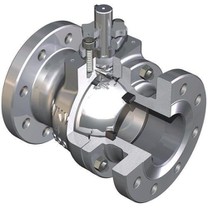



A two-way valve is a valve type that can achieve effective control and sealing in both forward and reverse medium flows.
1. Two-way sealing butterfly valve
Working principle
The valve plate and the valve seat sealing surface are completely symmetrical, which can withstand the pressure of two-way media and achieve two-way zero leakage.
Typical structures include three-eccentric metal sealing butterfly valves and double-eccentric soft sealing butterfly valves.
Application scenarios
Chemical processes (such as oil-water mixed medium transportation), nuclear power plant cooling water systems, municipal water supply pipelines, etc.
Advantages
Excellent two-way sealing, adaptable to high pressure difference and frequent opening and closing conditions.
2. Two-way flow hard-to-hard rotary ball valve
Working principle
The fluids in the two channels rotate in opposite directions through the valve, and a one-way rotation and reverse rotation structure is adopted.
When closed, it is closed only from one side, and when opened, both sides can be operated at the same time to avoid excessive pressure difference.
Application scenarios
Oil refining units (such as crude oil distillation), steam pipelines, seawater desalination systems, etc.
Advantages
Applicable to mixed media (such as oil and water, acid and alkali), with strong two-way pressure bearing capacity.
3. Bidirectional metal-sealed butterfly valve
Working principle
The sealing structure is specially designed to maintain good sealing when the medium flows in both forward and reverse directions.
The valve body and valve plate sealing materials are made of stainless acid-resistant steel (such as 1Cr18Ni9Ti).
Application scenarios
Water treatment, weakly corrosive gas and fluid transportation.
Advantages
Reliable bidirectional sealing, strong corrosion resistance and long service life.
4. Bidirectional eccentric hemispherical valve
Working principle
It consists of two hemispherical valve seats and a connecting shaft. The sealing ring slides between the two pieces of metal by rotating the shaft.
Application scenarios
Transporting media containing solid particles, high viscosity and fibrous substances.
Advantages
It is suitable for small diameter pipe sections, cutting off or connecting media, but cannot be used for throttling.
5. Bidirectional spiral gate (bidirectional plug valve)
Working principle
A handwheel drive is installed at the other end of the one-way spiral gate, which can be opened in both directions.
Application scenarios
In metallurgy, mining, building materials, food, chemical industry and other industries, control the transportation and flow regulation of solid materials and block and agglomerate materials of about 50mm.
Advantages
Simple structure, flexible operation, light weight, no jamming, fast opening and closing.
Six, two-way water supply rotary valve
Working principle
Installed at the junction of the water inlet pipe and the sewage discharge pipe, control the output of hot and cold water to avoid cross contamination.
Application scenarios
Automatic induction wash basins in public toilets, thermal systems, steam pipelines, petrochemicals, etc.
Advantages
Simple structure, easy to use, effective control of water flow direction and water quality safety.
Seven, two-way hard seal butterfly valve
Working principle
Adopting three-eccentric structure design, it can achieve sealing in both positive and negative directions.
Application scenarios
Petroleum, chemical, electric power, metallurgy, food, medicine and other industries.
Advantages
Two-way sealing, high pressure resistance, corrosion resistance, suitable for working conditions with a wide temperature range.